
Grace Baldauf, MSc Sustainable Urban Development student, University of Oxford
Towns have long been testing sites for public health strategy in the United Kingdom. From the early garden cities and model villages to the 2015 Healthy New Towns programme, planned settlements have served as the tabula rasa on which planners could imprint their visions of a healthy modernity.
Of course, these visions have not always led to the expected results. Many proved successful for the crises of the time but have spurred new challenges for future generations. Few have been as controversial as the post-war New Towns movement. While ambitious in their design, many new towns have struggled to stand the test of time. Nevertheless, they offer invaluable lessons on planning for health amidst a changing social and economic landscape.
From the destruction of the Second World War emerged new visions of modernity. The apparent success of early planned communities, such as Letchworth and Welwyn Garden City, had inspired confidence in the town planning movement. This optimism, combined with the urgent need for reconstruction, sparked growing calls for large-scale development. New towns were proposed to address the growing population and post-war chaos of existing urban centres.
The 1946 New Towns Act formally initiated the development of more than 20 towns, many located just outside of London’s Green Belt. While drawing on earlier traditions of model villages and the garden city movement, these new towns represented a move away from philanthropic social experiments towards a more government-led approach to community building. The first generation of new towns aimed to be economically self-contained, with active and socially mixed communities across all social classes. Health was a key consideration in planning decisions, with designs promoting walkability, recreation, and easy access to employment, healthcare, and welfare services.
Despite early intentions at social mixing, most new towns were targeted at young working-class families. Harlow New Town, for example, earned the moniker ‘pram town,’ as nearly 40% of its population were under the age of 15. Much of this targeting was intentional, with some new towns offering employment on arrival and many aiming to provide a range of shops and services within ‘pram pushing distance of every home.’ Generally, the towns featured a main shopping centre, then were subdivided into smaller neighbourhoods, or ‘villages,’ with a few local shops and services. Footpaths and cycle lanes led to various amenities, green spaces, and recreation centres—many of which were actively promoted by local committees.
However, as officials quickly realised, the extent of the post-war baby boom had been underestimated, and the availability of employment and services within the new towns could not keep pace with the growing population. Thus, subsequent generations of new towns became increasingly car-oriented, allowing for travel to and between other, more established towns and cities. The rise of the ‘car-owning democracy’ led to new perspectives on urban planning, with one Labour MP declaring in April 1960, ‘we must rebuild our whole environment of working and living in terms of the motor car.’ Thus, health became outranked by new priorities, including mass housing, individual choice, and economic development. This shift marked a broader uncoupling of urban planning from its public health foundations. As economic thought took a neoliberal turn, public health, too, was reframed as an issue of individual behaviour and therapeutics.
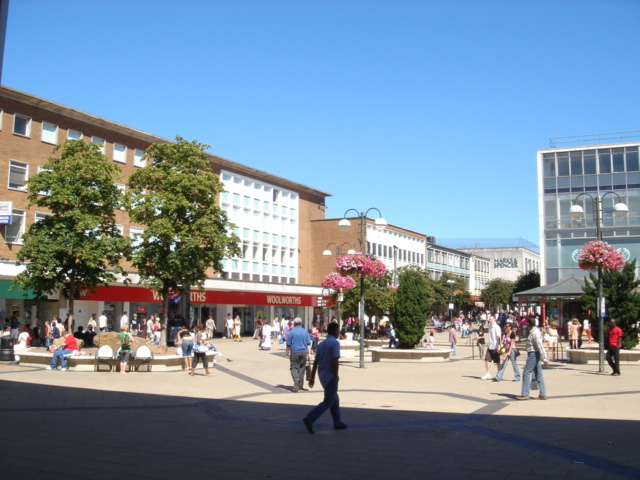
Photo: “Crawley.JPG” by Hassocks5489, via Wikimedia Commons. Public domain.

From 1979, social and welfare services within the new towns began facing cutbacks. Profits from the new towns were channelled back to the Treasury, rather than locally reinvested. Small-scale neighbourhood amenities and recreation began to disappear. The social and environmental conditions that had underpinned the new towns’ health ambitions became increasingly difficult to sustain. And in the decades since, these shifts have had lasting effects on the form and function of the new towns. Even today, many of the late-generation new towns remain among the most car-dependent areas in the UK, with Milton Keynes and Peterborough often topping the list.
The legacy of the New Towns experiment remains mixed. On one hand, the new towns represent some of the most ambitious attempts to design health into the built environment; on the other, their long-term trajectories have exposed significant limitations and inequalities. The early new towns reflect many of the best practices that are today associated with positive health outcomes: walkability, ample green spaces, recreation, and community building. Later generations of new towns prioritised car usage, forgoing a collective health perspective for individualised health management and a focus on economic development.
However, almost all of the new towns were designed for young, economically active individuals — not the burgeoning population of over-65s who have aged in place. And as the demographic landscape has changed, the prevailing health challenges look different too. Many of the design solutions intended for public health have paved the way for new forms of unhealthy towns, exacerbated by increasing market dependency and individualization. Early zoning and low-density housing, for example, aimed to protect residents from pollution and disease, but have also entrenched the dispersed, car-dependent landscapes contributing to social isolation and chronic illness. While these effects were initially mitigated by local services, later cuts to public funding and reduced reinvestment have eroded many neighbourhood amenities and town centres.
Entering the 21st century, a range of initiatives have sought to reintegrate health into town planning discourse. From the UK Healthy Cities and Towns network to the NHS Healthy New Towns programme, these initiatives recognise the importance of placemaking in improving health outcomes. However, the emphasis often remains on downstream interventions: behaviour change, education, and disease management. Solutions include designing ‘dementia-friendly’ infrastructure, encouraging improved health education in schools, and facilitating online GP appointments to manage health from home. While these interventions are important for managing individual health, a return to a prevention-focused, holistic approach to public wellbeing will prove essential in addressing the root causes of today’s health crises.
Revisiting the post-war new towns may provide valuable lessons for the future of small settlements and cities alike. These towns reveal how health can be embedded in planning and governance, and the risks of failing to consider potential path dependencies. They show that, even when designed with the best intentions, towns cannot maintain or adapt their health-promoting features without sufficient support and reinvestment. In this sense, their legacy lies as much in what they became as in what they were intended to be.