
Ava Peralta, BA (Hons) Geography student, University of Oxford
The publication of the UK New Towns Taskforce, set against a backdrop of rapid global urban expansion and the deepening ‘polycrisis’ of the Anthropocene, signals a renewed commitment to purposive placemaking. Drawing on the findings of a scoping review of literature published since the turn of the century, this blog examines the significance of cross-industry collaboration in this endeavour. While it begins by reaffirming the importance of collaboration across sectors, the blog also turns a critical lens on the conditions that currently limit its transformative potential, with particular attention to behavioural misalignments and a shallow engagement with the politics of difference. Without confronting these challenges, cross-industry collaboration risks becoming yet another buzzword, one that obscures enduring logics of stratification in placemaking, rather than opening pathways towards a just and sustainable future.
The significance of cross-industry collaboration becomes most apparent when place, in this context the urban built environment, is understood as a site of world-making. The organisation and construction of the urban fabric shape our shared ‘common sense’ by influencing social practices, political possibilities, and, crucially, the futures that are deemed possible. Today, in the form of ‘Western modernity’, this common sense is one underpinned by capitalism, a system inextricable from logics of continual growth and stratification. If such frameworks are incompatible with a just and sustainable future, then we must also interrogate how the built environment helps to reproduce these values, and how it might instead be mobilised to resist them.
Understanding the urban as a laboratory for world-making experimentation frames new towns as an opportunity to break from business-as-usual approaches, and deliberately re-imagine how urban futures are produced. By positioning the actors involved in new town creation as custodians of the common senses through which life is organised, the inclusion of diverse forms of knowledge, expertise, and value in their planning and execution becomes not only desirable, but imperative. Plurality in planning and production, in turn, translates into plurality in being, a necessary condition for a just tomorrow.
However, significant fetters to the realisation of this vision of cross-industry collaboration persist, undermining its transformative potential. The first of these concerns the behavioural mechanics of collaboration. Across literature spanning management studies, construction studies, and sociology, research highlights how sector-specific mannerisms, outlooks, and motivations can render the lived experience of collaboration challenging in practice. Even seemingly banal differences, such as sector-specific language, professional dispositions, and behavioural norms, have been shown to materially affect levels of trust, commitment, and sustained engagement in collaborative endeavours.
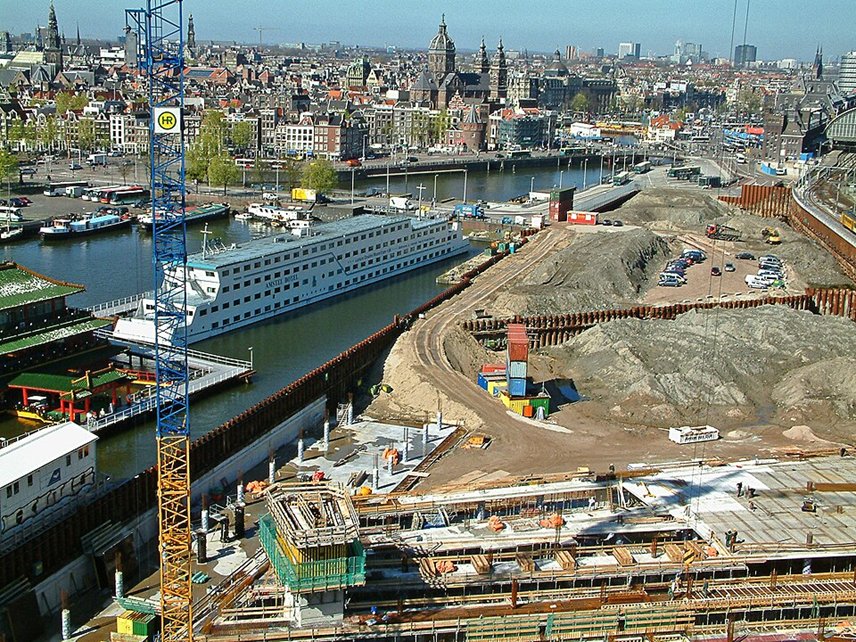
Source: Amsterdam constructions by Fons Heijnsbroek (File:Photo-cityscape-constructionssite-Amsterdam-Oosterdok-2005-high-resolution-image.jpg – Wikimedia Commons)

In the context of new town development, projects characterised by high levels of complexity and uncertainty, divergent sectoral responses to change and risk become particularly pronounced. These challenges are further compounded by the physical distance that often separates stakeholders, inhibiting the formation of trust-based relationships, alongside enduring stereotypes associated with particular sectors that shape how actors perceive and interact with one another. At the core of these tensions lies a lack of practiced experience working within genuinely cross-sectoral teams: collaboration is a learned, not natural, skill in which difference must be actively expected and valued rather than merely tolerated. Collectively, these dynamics contribute to a persistent gap between the discourse of collaboration and its concrete realisation, raising concerns that collaboration risks becoming a hollow buzzword, invoked rhetorically rather than enacted meaningfully.
The second fetter impeding transformative collaboration, arguably running far deeper than behavioural misalignments, concerns the enduring power politics embedded within collaborative processes. Critical scholars challenge idealised visions of collaboration as an inherently altruistic and neutral endeavour in which a broad spectrum of actors is invited to the table and their voices are equally heard. Instead, these critiques draw attention to how collaborative processes often reproduce existing hierarchies of knowledge.
This dynamic is particularly evident in new town developments beyond the Global North, where modernist architectural masterplans are frequently replicated across diverse contexts with limited attention to place-based specificity. Such approaches are commonly underpinned by an over-reliance on planning expertise outsourced to large firms headquartered in the Global North. While these urban forms have come to symbolise national strength and modernity, it is increasingly recognised that, behind this facade, they struggle to engage with the social, cultural, and political complexities of urban life. In these contexts, those with intimate knowledge of place articulating alternatives beyond dominant Western logics are rarely listened to with equal weight. Notably, Indigenous ontologies and knowledge systems, in their multiplicity, remain largely absent from large-scale master-planning and construction processes.
What emerges is collaboration mobilised to reproduce the status quo rather than to enable radical transformation. At its core are profound systemic debates that extend far beyond the case of new towns, centring on who is deemed worthy of collaboration, a question that cuts to the heart of who is considered human and the persistence of the human–nature fallacy. This reveals that the inclusion of multiple sectors does not, in itself, guarantee a plurality of perspectives. Sustained attention to who is invited to the table and, once present, who holds the power to speak therefore remains essential as cross-industry collaboration continues to proliferate in contemporary urban development practice.
Today, for me, marks a moment of polycrisis, characterised by mounting stressors across society, the economy, and the environment. Against this backdrop, it is increasingly difficult to sustain the belief that business-as-usual approaches are sufficient to produce a just and sustainable future. Drawing on the findings of a scoping review, this blog has argued that while cross-industry collaboration will be central to articulating alternative futures, its transformative potential is currently constrained not only by practical and behavioural challenges, but also by a shallow diversity of ontological perspectives. If collaboration is reduced to a procedural tick-box, mobilised primarily to secure funding, the substance of action risks dissolving behind discursive smoke screens and institutional loopholes. What is required instead is a deeper affective and ethical commitment, one that engages seriously with ideas and worldviews beyond our own. Although collaboration in this space will undoubtedly be uncomfortable, we must remain steadfast in working through, rather than retreating from, this discomfort. The New Towns Task Force has an opportunity to lead by example in this regard. If such a commitment is genuinely embraced, collaboration can move beyond rhetoric and become a meaningful vehicle for transformation.