
Greta Stone, BA English Student, University of Oxford
Village life: chatting to neighbours, bumping into friends at the local pub, children playing on the green, all while surrounded by beautiful nature. It sounds idyllic, like a dream, even – but maybe that’s all it is. Does this kind of traditional village community exist anymore? If it does, does it still make for a desirable way of life in today’s world? This scoping review details some ways in which the social function of historic settlements can influence and be adapted to produce newer, often larger modern developments. From aspects of their physical design to their use of new technologies, traditional village communities offer valuable guidance with which we can better develop sustainable, connected, and community-focused modern lives.
Traditional village life has long influenced urban design theory, often for what are said to be its desirable innate qualities – ‘security, sociability and economic purpose’ [1]. Focusing within these on sociability, there are four main concepts that have been used to foster a village-like sense of community in larger new settlements, often through the designed area’s physical geography: community attachment, for example through ownership of land; community identity – through feeling that the place you live is unique, significant, and cohesive; social interaction – through formal and informal, planned and unplanned meetings with others; and pedestrianism – the neighbourhood being walkable and connected [2]. In these ways, small settlements offer useful social frameworks for new developments, which can in turn bridge the gap between the traditional way of life and the modern world.
Similarly, a study of two suburbs of Houston, Texas exemplifies the social value of these design principles, with particular focus on connection between indoor and outdoor life through front porches, green sidewalks, and pedestrian trails leading to open nature [3]. Clearly, the social and physical structures of the traditional small settlement are useful in developing connected and healthy modern communities. However, what both these studies also note is the importance of choice and control over where one lives – those who live in the less connected, less community-driven areas in Maryland may value more privacy and space [4]. Having a say over where you live, it seems, is one of the most important aspects of modern living.
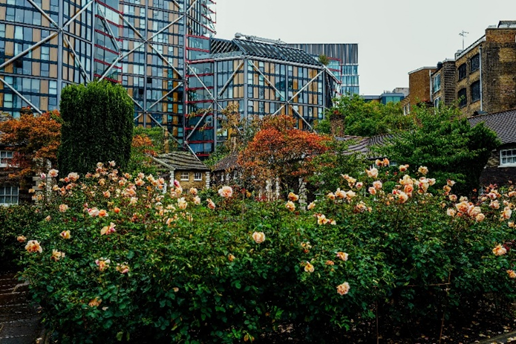
Photo: Adrien Olichon / Pexels
In a similar vein, Stuart Hodkinson highlights the importance of a shared sense of choice and control over where and how people live, in both old and new settlements [5]. He details how the introduction of enclosure in the early modern world led to diminished ‘common’ land, and, as a result, ‘the extinction of the village community’ [6]. Not only does Hodkinson demonstrate the importance of shared open space in fostering social interaction (not to mention its economic and environmental benefits), he also queries the widespread nostalgia surrounding village life. In reality, after enclosure it was defined by strict social hierarchy, privatisation, and ultimately a lack of control. Therefore, he queries the legacy of this feudalism that still underpins many modern neighbourhood developments literally built in the shadow of the big house, company, or landowner that funded them. In light of this, Hodkinson highlights the importance of producing ‘urban commons’, in which the city and other modern neighbourhoods function as accessible, shared resource pools and spaces of sociality – fostering social interaction through physical space [7]. A study of community gardens in urban and rural areas of New York state exemplify the social, economic, and environmental benefits of ‘commons’; in fact, people recorded greater social benefits in urban areas than rural, perhaps due to more intentional use of the spaces as means for interaction and cohesion [8].
This concept of the ‘commons’ points also to the importance of democratic control of neighbourhoods. A study of the Island of Gigha in Scotland demonstrates a turn away from the neo-feudalistic land ownership that defines many smaller rural communities, as its residents came together to buy their land from the private owner and take ‘control of [their] own destiny’ [9]. This illustrates the kind of community resilience that small settlements can foster, and that is consolidated by democratic, common ownership of land. The subsequent installation of a small sustainable wind farm and an increase in population on Gigha highlight the intertwined environmental and economic benefits borne out of positive sociality, clearly endorsing a focus on the tripartite model (security, sociability, and economic purpose) of village life when developing modern larger settlements [10].
Finally, we must recognize a uniquely modern element of small settlements – use of the internet. Through online platforms, groups, and media, communities are more ‘imagined’ than ever, and yet as a result they are also more real. A study of two semi-rural Scottish towns demonstrates how, perhaps unexpectedly, the internet is being harnessed to solidify community and civic mindedness, although only most effectively when used in combination with more traditional geographical neighbourhood features – the common green, village hall, and centralised shopping streets [11]. Not only this, but the online community might actually lead to more egalitarian relationships between members, and function more naturally than traditional real-life village communities due to ‘underlying human predispositions for relatively loose and fluid social bonds’ [12].
Overall, the evidence makes clear that small settlements can offer useful social frameworks for new, bigger developments, particularly in their community connection and resilience that are often bolstered by features of physical geography. However, much evidence also highlights the fact that today’s world requires a move away from the historic, feudalistic systems that often underpin these settlements and their communities – we must ensure that modern developments are rooted in choice and control on an individual level, and, importantly, on a democratic ‘common’ scale.
References
[1] Neal, P. (2005) Urban Villages and the Making of Communities. Spon Press, p. 4. doi: https://doi.org/10.4324/9780203402771
[2] Kim, J., and Kaplan, R. (2004), ‘Physical and Psychological Factors in Sense of Community: New Urbanist Kentlands and Nearby Orchard Village’. Environment and Behavior, 36(3), pp. 313-340. doi: https://doi.org/10.1177/0013916503260236.
[3] Rogers, G.O., and Sukolratanametee, S. (2009), ‘Neighborhood design and sense of community: Comparing suburban neighborhoods in Houston, Texas’. Landscape and Urban Planning, 93(3-4), pp. 325-334. doi: https://doi.org/10.1016/j.landurbplan.2009.05.019.
[4] Joongsub and Kaplan. (2004), ‘Physical and Psychological Factors in Sense of Community: New Urbanist Kentlands and Nearby Orchard Village’. p. 334
[5] Hodkinson, S. (2012). ‘The new urban enclosures’. City, 16(5), pp. 500-518. doi: https://doi.org/10.1080/13604813.2012.709403.
[6] Hodkinson, S. (2012). ‘The new urban enclosures’, p. 503.
[7] Hodkinson. (2012). ‘The new urban enclosures’. p. 501.
[8] Armstrong, D. (2000). ‘A survey of community gardens in upstate New York: Implications for health promotion and community development’. Health & Place, 6(4), pp. 319-327. doi: https://doi.org/10.1016/S1353-8292(00)00013-7
[9] Satsangi, M. (2009). ‘Community Land Ownership, Housing and Sustainable Rural Communities’. Planning Practice & Research, 24(2), pp. 251-262, p 258. doi: https://doi.org/10.1080/02697450902827402.
[10] Neal. (2005) Urban Villages and the Making of Communities, p. 4.
[11] Beel, D., Luguzan, C., Townsend, L., Vincent, K. and Wallace, C. (2017). ‘Information technology and social cohesion: A tale of two villages’. Journal of Rural Studies, 54, pp. 426-434. doi: https://doi.org/10.1016/j.jrurstud.2016.06.005.
[12] Brint, S. (2001). Gemeinschaft Revisited: A Critique and Reconstruction of the Community Concept. Sociological Theory, 19(1), pp. 1-23, p. 20. doi: https://doi.org/10.1111/0735-2751.00125.